

Private Funds Update: November 19, 2026
SEC enforcement volume fell again in fiscal year 2026 as the agency launched a super intelligence office. Plus: a proposed rewrite of executive pay disclosure with relief for BDCs and closed-end funds, ILPA's final continuation vehicle guidance, and NAV financing in Asia-Pacific.

This week at a glance
- SEC enforcement: Case volume fell again in fiscal year 2026, while the Division of Enforcement launched a dedicated super intelligence office and rewrote its playbook.
- Executive pay disclosure: The SEC proposed a rewrite of Item 402 of Regulation S-K, with timing relief that reaches BDCs and closed-end funds filing on Form N-2.
- Continuation vehicles: ILPA's final guidance sets a 20-clear-business-day election period and moves to a principles-based approach.
- Fund finance: NAV and hybrid facilities took center stage at the Asia-Pacific Fund Finance Symposium in Singapore.
1. SEC enforcement: fewer cases, more individuals and a new super intelligence office
The SEC filed 348 enforcement actions in fiscal year 2026 and obtained orders for $1.095 billion in monetary relief, according to results announced on November 10, 2026. That is down 24% from 456 actions in fiscal year 2025, and the third straight annual decline.

Why it matters: Volume is down, but the Division of Enforcement spent the year changing how it finds and builds cases. Private fund advisers should expect fewer sweeps and faster, more data-driven investigations.
By the numbers, from the SEC's addendum:
- 235 standalone actions, 47 follow-on proceedings and 66 delinquent-filing cases
- $752 million in disgorgement and prejudgment interest, plus $343 million in civil penalties
- Two-thirds of standalone actions charged at least one individual
- About $731 million returned to more than 250,000 harmed investors
What changed inside the Division:
- A super intelligence office. The new Office of Super Intelligence and Analytics puts SI tools directly into investigations. Its work includes anomaly detection, faster review of documents and transcripts, and blockchain and financial-flow analysis.
- A new Enforcement Manual. The Division updated the Manual for the first time since 2017. The update standardizes the Wells process and explains how cooperation affects civil penalties.
- No more no-deny. The Commission rescinded Rule 202.5(e), so settling parties no longer have to agree not to publicly deny the allegations.
Where private fund advisers showed up:
- Pre-IPO secondaries. The SEC charged Adit Ventures Management and Meyer Global Management with allegedly defrauding investors in funds holding pre-IPO shares.
- Custody Rule. Settled orders found violations of Advisers Act Section 206(4) and Rule 206(4)-2.
- Fees and valuation. Settled orders addressed fee offset practices that did not match disclosures, and loans sold to private fund clients without a reasonable fair market value determination.
- Filings and safeguards. Other actions covered late or inaccurate Schedule 13D filings and Rule 30(a) of Regulation S-P.
The bottom line: A lower case count is not a lighter touch. With SI-assisted document review and a standardized Wells process, advisers should expect investigations to move faster. Custody, fee and disclosure practices remain squarely in scope.
2. SEC proposes a rewrite of executive pay disclosure, with timing relief for BDCs and closed-end funds
On November 13, 2026, the SEC proposed amendments to Item 402 of Regulation S-K that would make executive and director pay disclosure principles-based and driven by materiality (Release No. 33-11455; File No. S7-2026-39).
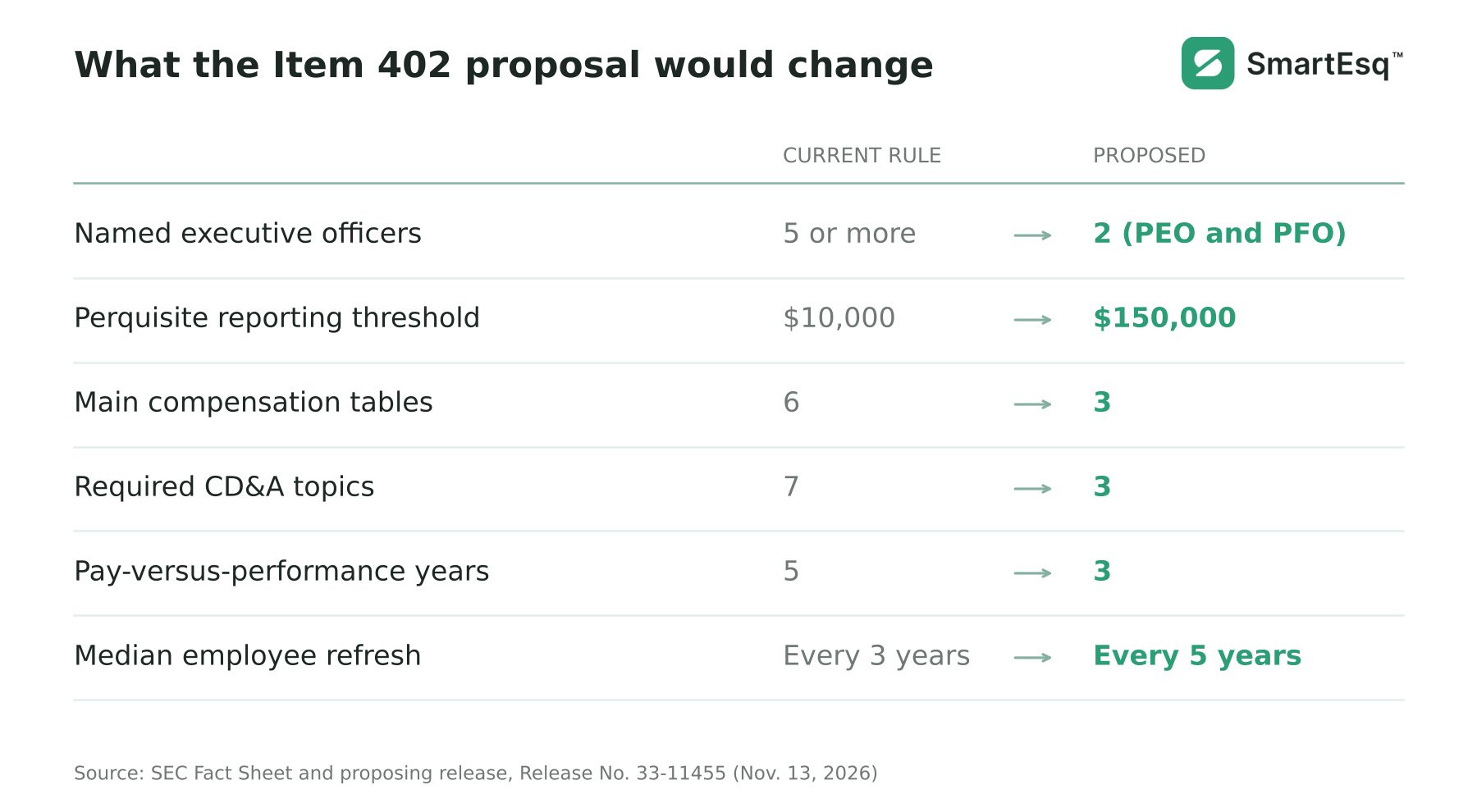
Why it matters for funds: Most of the proposal targets operating companies, but two pieces reach registered funds and BDCs.
- "New year" relief on Form N-2. Registrants using long-form registration statements, including Form N-2, would have up to 120 days after fiscal year-end to add pay disclosure for the year just ended. That is the same window short-form filers already have. It removes a timing problem for BDCs and closed-end funds raising capital early in the year.
- Form N-CSR clawback disclosure. The SEC proposes to remove Item 18(b) of Form N-CSR, which applies to listed funds subject to Exchange Act Rule 10D-1.
Also in the proposal, per the SEC's fact sheet:
- Three new tables (Earned Compensation, Granted Compensation and Status of Equity Awards) would replace the current tables, including the Summary Compensation Table.
- The Pension Benefits and Nonqualified Deferred Compensation tables would be eliminated.
- Disclosure on compensation-related risk and on equity grants timed near material nonpublic information would be eliminated.
- Inline XBRL tagging of clawback disclosure would no longer be required.
The big picture: Chairman Paul Atkins has described the proposal as the second of three pillars in his plan to refocus public company disclosure on materiality. The first was the May 19, 2026 filer status proposal.
What's next: The proposal was published in the Federal Register on November 19, 2026. Comments are due 60 days after publication. Existing rules apply until any final amendments take effect.
3. ILPA finalizes its continuation vehicle guidance
The Institutional Limited Partners Association published its final guidance, Continuation Vehicles: Advancing Alignment Through Best Practices, on October 20, 2026. It replaces ILPA's 2023 guidance and is available on ILPA's continuation funds page.
What's new: The final version is principles-based. It drops the "comply or explain" approach of the draft released in June.
- Election period: at least 20 clear business days from receipt of the final election pack.
- LPAC notice: at least 10 business days before the conflicts waiver meeting, with the ILPA Continuation Fund Disclosure Template or an equivalent.
- Rolling LP economics: comparative modelling should show no overall increase in management fees or in blended, risk-adjusted carried interest.
- Election options: a "remain in place" option is no longer expected by default.
- Insurance costs: the R&W insurance premium should be disclosed separately and allocated by who benefits.
The bottom line: Sponsors running GP-led secondaries should expect LPs and LPAC members to measure disclosure, fee terms and conflict waivers against this guidance.
4. APAC fund finance: NAV and hybrid facilities move to the mainstream
NAV and hybrid facilities dominated discussion at the Fund Finance Association's 8th Annual Asia-Pacific Fund Finance Symposium, held in Singapore on November 4, 2026.
- NAV lending: practitioners report loan-to-value ratios of about 20% to 30% in the region, reflecting concentrated portfolios.
- Hybrids: facilities that combine subscription-line and NAV features were described as the fastest-growing segment.
- Insurance capital: a Moody's survey found fund finance rose to 1.9% of rated U.S. life insurers' cash and invested assets in 2025, from 1.3% in 2024.
- Fund documents: legacy LPAs are often silent or restrictive on NAV borrowing.
- Valuation: it remains the central negotiating point, and regulators including the Australian Securities and Investments Commission are watching private credit valuations.
The bottom line: Sponsors raising new APAC funds should make sure the LPA expressly permits NAV borrowing, and should avoid limiting leverage only at the fund level so facilities can also sit at the SPV level.
Sources
- SEC, Press Release 2026-113: SEC Announces Enforcement Annual Results for Fiscal Year 2026 (Nov. 10, 2026)
- SEC Division of Enforcement, Addendum to Press Release, Fiscal Year 2026
- SEC, Press Release 2026-20: Updates to the Enforcement Manual
- SEC, Press Release 2026-45: SEC Rescinds Policy Regarding Denials of Settlements in Enforcement Actions
- SEC, Press Release 2026-114: SEC Proposes Executive and Director Compensation Disclosure Reforms (Nov. 13, 2026)
- SEC, Executive Compensation Disclosure Reform, File No. S7-2026-39
- SEC, Fact Sheet: Executive Compensation Disclosure Reform
- Federal Register, Executive Compensation Disclosure Reform (Nov. 19, 2026)
- ILPA, Continuation Funds
- Fund Finance Association, 8th Annual Asia-Pacific Fund Finance Symposium
This update is for general information only and is not legal advice.
